



Understanding the Syringe Sliding Performance Tester: Principles, Standards, and Measurement Methods
2026-10-05 09:15Understanding the Syringe Sliding Performance Tester: Principles, Standards, and Measurement Methods
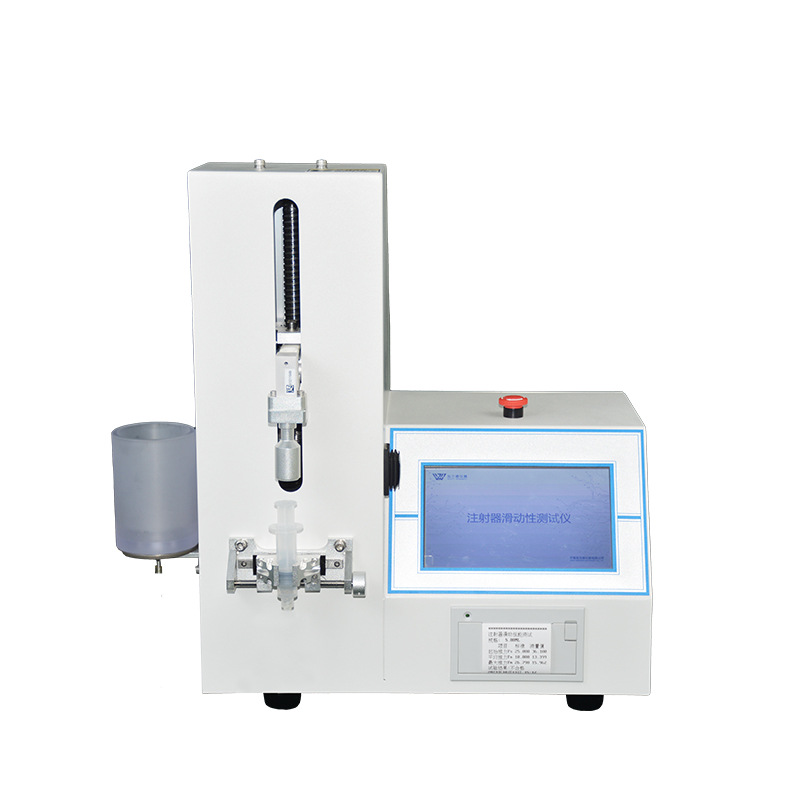
Sliding performance is one of the defining mechanical characteristics of a disposable hypodermic syringe. It describes how much force the plunger requires to start moving, how steadily that force behaves while the plunger travels, and how the assembly responds when the plunger is pushed back. Because the same motion governs both drug withdrawal and injection, sliding performance is treated as a mandatory release test in syringe manufacturing plants, third-party laboratories, and regulatory inspection programs worldwide. The dedicated instrument for this measurement appears in industry literature under several equivalent names — syringe sliding performance tester, syringe plunger glide force tester, and, when the emphasis falls on the initial movement of the plunger, syringe break loose force tester. All of them refer to a motor-driven force-measurement syringe testing machine built around one principle: drive the plunger at a controlled speed and record the force–displacement response of the barrel–plunger assembly. This article explains what such a syringe tester measures, how the standardized procedure is executed, and which instrument characteristics a laboratory should verify.
Part I. Understanding Syringe Sliding Performance
Part I explains what sliding performance means as a quality attribute and how a dedicated tester measures it physically.
1. What Sliding Performance Actually Measures
A syringe is a simple mechanism: an elastomeric plug sliding inside a rigid or semi-rigid barrel, lubricated with a thin film of silicone oil. Its clinical performance depends on whether that sliding motion stays predictable under real use conditions — one-handed operation, slow or fast injection, viscous drug formulations. Sliding performance testing quantifies this predictability through four defined force quantities and one continuous record.
1.1 Break-Loose Force (Starting Force)
The break-loose force is the peak force required to initiate movement of a stationary plunger. It is measured first, while the plug is still at rest against the static friction of the barrel wall. If the starting force is too high, a clinician using one hand may experience hesitation or an involuntary overshoot at the moment of injection; for patient-use devices such as insulin syringes, excessive break-loose force is a direct usability and safety concern. A syringe break loose force tester therefore has to resolve the force peak with sufficient sampling speed — a low-frequency data recorder can miss the true break-loose value entirely.
1.2 Average Glide Force
Once the plug is moving, the relevant quantity is the force needed to sustain motion at a defined velocity — the glide force. Standards specify reporting the average glide force over the working stroke, because the instantaneous value fluctuates continuously. Glide force is primarily a function of the silicone lubricant film: too little coating raises friction and causes stick-slip; too much coating risks contamination of the drug and inconsistent force readings.
1.3 Maximum and Minimum Push-Back Force
Sliding performance is not only about forward injection. The return stroke — pushing the plunger back toward its seated position, which is the counterpart of the withdrawal used to fill the syringe — is evaluated through its maximum and minimum push-back forces. The spread between the two extremes indicates whether the plug sticks and releases unevenly along the barrel length, a signature of geometric or lubrication variation.
1.4 The Force–Displacement Curve
Beyond single values, the complete record of force against plunger travel is part of the measurement result. A healthy, well-lubricated assembly produces a relatively flat curve with small ripple; localized spikes usually correspond to barrel ovality, mold witness lines, or defects in the plug's sealing fins. For this reason, a modern syringe sliding performance tester displays the plunger movement-versus-force record in real time during the test, rather than only a final numeric result.
2. The Physical Test Principle
The measurement principle of a syringe plunger glide force tester is mechanical and direct. The syringe barrel is rigidly fixed in a dedicated fixture, and a drive system grips the plunger head and applies force to one end of the core rod at a constant, standardized speed. Two load cases are executed in sequence.
2.1 Tension (Withdrawal) Stroke
The plunger is pulled at the reference speed, drawing water or a reference fluid into the syringe until the nominal graduated capacity line is reached, while the force is continuously recorded. This stroke reproduces the drug-withdrawal phase of clinical use.
2.2 Compression (Injection) Stroke
After a short programmed dwell, the plunger is pushed back at the controlled speed, expelling the fluid into a collection vessel, again with continuous force recording. This stroke reproduces the injection phase.
The fluid circuit is intentional: filling and emptying with water reproduces the working condition the device sees in practice and prevents the pressure differential across the plug from being excluded artificially. The resulting data set comprises the starting (break-loose) force, the average glide force, the maximum and minimum push-back forces, and the full force–displacement records of both strokes.
Part II. tandards Framework
Understanding which standard governs which product family helps when specifying a syringe testing machine for a particular laboratory or registration program.
3.1 ISO 7886-1
ISO 7886-1:2017 sets the general requirements for disposable sterile syringes intended for single-handed manual use, including the mechanical properties: plunger pull force, break-loose and glide behavior, and leakage resistance. It is the baseline reference for export-oriented production and for suppliers into international immunization programs.
3.2 ISO 8537-2016
ISO 8537 covers disposable syringes with means for automatically disabling use — auto-disable designs used widely to prevent reuse. The additional locking and retracting mechanisms interact with plunger force, so sliding performance is evaluated with this standard's variant requirements.
Part III. Instrument Specification and Quality Role
Part III translates the protocol requirements into concrete instrument specifications, shows which failure modes the test detects, and positions the instrument within the manufacturing quality system.
4. Instrument Requirements and a Representative Specification
A compliant instrument is a purpose-built single-axis force frame with dedicated syringe fixtures, not a general tensile tester with improvised grips. The specification of a representative medical syringe sliding tester illustrates what laboratories expect from the measurement chain upward.
4.1 Measurement Chain
A force range of 0 N to 100 N with an accuracy of ±1% of full scale covers the full population of syringe force limits while retaining resolution at the low-force end, where insulin and pediatric devices operate.
4.2 Motion and Dwell Control
Test speed adjustable from 5 to 1000 mm/min (protocol value 100 ± 5 mm/min) together with a programmable 30 ± 1 s dwell between withdrawal and return strokes ensures that the standardized procedure can be executed automatically and reproducibly.
4.3 Interface and Result Handling
A 7-inch color touchscreen displays the starting force, average force, maximum push-back force, minimum push-back force, and the plunger movement-versus-force record in real time. The intelligent controller selects the nominal capacity, applies the standard's limit table, auto-judges each result, and prints the report from an onboard printer — a practical feature on production floors where network access is restricted and paper traceability is still expected during audits.
4.4 Fixtures and Physical Footprint
Standard configurations include syringe-holding fixtures spanning 0.1 mL to 100 mL nominal capacity, so one bench instrument serves an entire product catalogue. The compact footprint of approximately 400 × 290 × 275 mm and a net weight of 15 kg allow placement inside a quality-control laboratory or beside a filling line.
5. Where the Instrument Sits in the Quality System
Within a syringe manufacturer, a syringe sliding performance tester appears at several control points: incoming inspection of rubber plugs and silicone-coated barrels, in-process verification after assembly and lubrication, final batch release against AQL sampling schemes, and stability or transport-validation testing. Third-party laboratories use the same equipment for regulatory submissions, and pharmaceutical manufacturers assembling pre-filled syringes use it for component qualification under the ISO 11040 framework.