



How Condom Bursting Volume and Pressure Are Measured
2026-08-31 16:14A condom is a barrier device whose entire function depends on remaining intact under stress. It must not leak, it must not tear, and it must not fail when subjected to the pressures of normal use. To guarantee this, manufacturers and regulators rely on a specific type of laboratory test: the measurement of bursting volume and pressure. The instrument that performs this measurement is known in the industry as a condom bursting volume and pressure tester. This article explains what the test measures, how the instrument works, and why it is central to condom quality assurance.
What the Test Measures
The bursting test records two related properties. The first is bursting pressure, the internal air pressure at the moment the condom ruptures. The second is bursting volume, the amount of air the condom can hold at the point of failure. Together, these two values describe how much mechanical stress a condom can withstand before it breaks.
These are not abstract numbers. A condom that bursts at too low a pressure, or that cannot inflate to a sufficient volume, is a product that may fail during use. The test therefore serves as a direct check on the strength and reliability of the material, whether it is natural rubber latex or a synthetic alternative such as polyurethane or polyisoprene.
How the Instrument Works
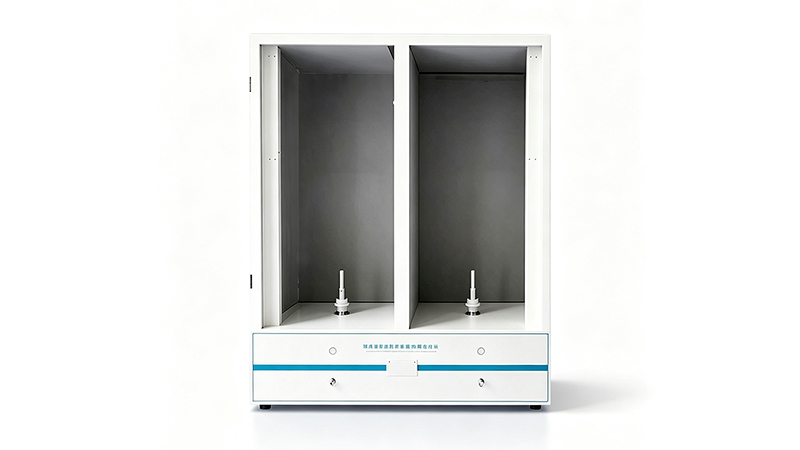
A condom burst pressure tester operates on a straightforward principle. The condom is fitted over a mandrel, or inflation rod, and secured in place with a clamp or air-inflated collar. The instrument then inflates the condom with air at a controlled rate, while a pressure sensor continuously records the internal pressure. At the same time, a volume-measuring system tracks how much air has been introduced.
As inflation continues, the condom expands. The pressure rises, then reaches a maximum, and finally falls sharply as the material ruptures. The instrument records the pressure and volume at the exact point of failure. Modern instruments display these values on a screen and generate a report automatically, so that the result can be reviewed and archived without manual calculation.
The rate of inflation matters. If air is introduced too quickly, the result may differ from a test conducted slowly. Standards therefore specify the inflation conditions carefully, and the instrument must be able to control them precisely and repeatably.

Standards That Govern the Test
The measurement of bursting volume and pressure is defined by international standards. The most important is ISO 4074, the international standard for rubber condoms, whose Part 6 specifies the determination of bursting volume and pressure.
The standards specify not only the test procedure but also the minimum performance that a condom must achieve. A condom must exceed a minimum bursting volume and minimum bursting pressure to be considered acceptable. The condom burst tester is the instrument used to verify this compliance, and its accuracy is therefore a matter of regulatory importance.
Why the Test Matters
The bursting test sits at the heart of condom quality control. Alongside tests for freedom from holes, tensile strength, and dimensions, it forms part of a battery of checks that every production batch must pass before it can be released to market. National drug and medical-device authorities, quality-inspection bodies, and independent laboratories all use the test to confirm that products meet the required standard.
Because condoms are classified as medical devices in most countries, the consequences of a failing product are significant. A condom that bursts under normal conditions is not merely a defective item; it is a product that has failed in its essential purpose. The test exists to prevent such failures from reaching the consumer.
Practical Considerations for Testing
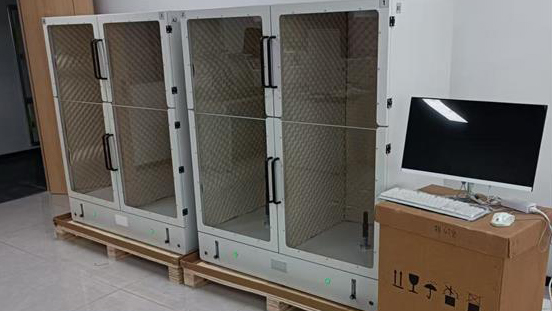
Several factors influence the reliability of a bursting test. Sample handling is critical: condoms must be stored and prepared under controlled conditions, because temperature and humidity can affect the properties of latex. The inflation mandrel and clamps must be clean and undamaged, since surface defects can cause premature rupture. The instrument itself should be calibrated regularly, and the pressure and volume sensors should be verified against known references.
The test is also inherently destructive. Once a condom has been inflated to the point of rupture, it cannot be used again. Testing therefore always involves sampling: a defined number of condoms are drawn from a production batch, tested, and the results used to judge the batch as a whole. This is why sampling plans and statistical acceptance criteria are a standard part of the relevant standards.
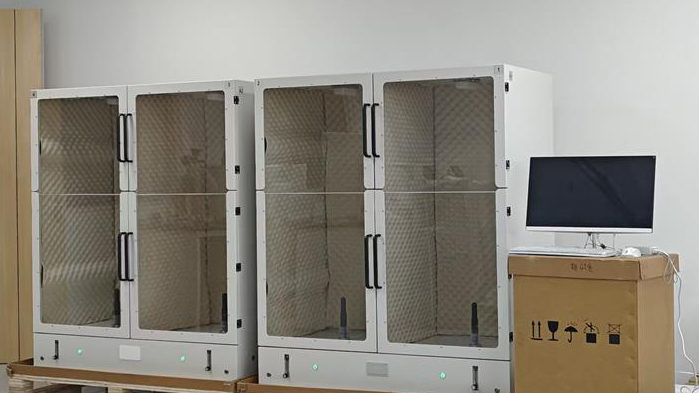
The bursting volume and pressure test is a cornerstone of condom quality assurance. By inflating a condom to the point of failure and recording the exact pressure and volume at which it bursts, the condom bursting volume and pressure tester provides a direct, objective measure of the product's strength. Governed by standards such as ISO 4074, and supported by a wider range of condom testing equipment, the test helps ensure that the products reaching consumers can be relied upon to perform their essential function. In an industry where failure is not an option, this measurement is indispensable.