



Understanding the Holding Power Tester: How Long an Adhesive Holds Under Load
2026-08-28 16:37Some adhesives grip instantly. Others hold for a long time. These are not the same thing, and confusing them leads to real-world failures: a hook that falls off the wall after two days, a shipping tape that slowly peels back in a warm warehouse, a label that creeps out of alignment on a bottle. The property that governs these failures is called holding power, or shear adhesion, and it is measured by a dedicated class of instruments.
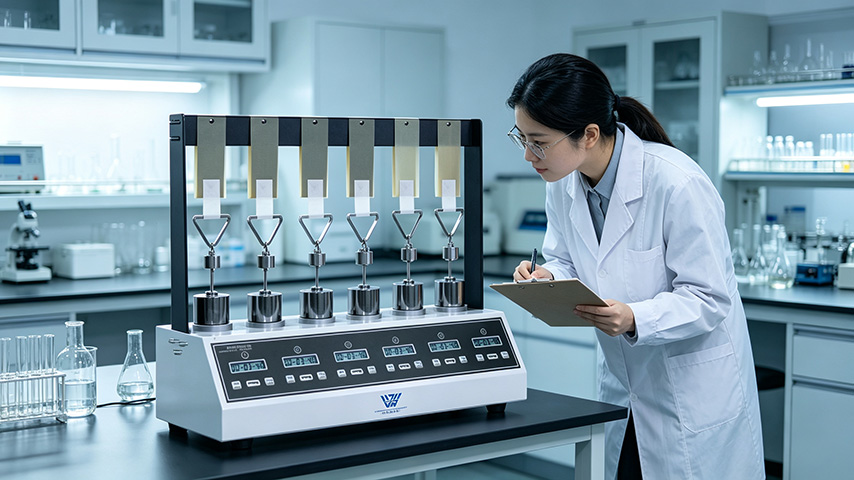
The general category of equipment used for this kind of work is often referred to as a pressure sensitive adhesive tape tester or, more broadly, an adhesive tape testing machine. Within that category, the instrument that specifically measures how long a bonded tape resists a steady shear load is the holding power tester, also called a shear adhesion or static shear tester.
The Difference Between Tack and Holding Power
To understand holding power, it helps to contrast it with initial tack. Initial tack is the immediate grab: how quickly an adhesive forms a bond under light, brief contact. Holding power is the opposite end of the behaviour: how long that bond survives under a constant, sustained force.
A tape can be excellent at one and poor at the other. A high-tack tape may grab a surface instantly but creep and slide when a weight is hung from it. A high-shear tape may resist a load for days but feel sluggish to apply. Because these properties are independent, they must be tested independently, and a tape adhesion test instrument must be chosen to match the specific property a manufacturer needs to control.
How Holding Power Is Measured
The test itself is conceptually simple. A strip of tape of standard width is applied to a standard test panel—usually a flat stainless steel plate with a specified surface finish. A standard mass is then hung from the free end of the tape, applying a constant shear load. The test records how long the tape remains bonded before it slides a defined distance or falls away completely.
The simplicity of the setup is deceptive. For the result to be comparable between laboratories, every variable must be controlled: the mass of the weight, the dimensions of the tape sample, the overlap area, the material and finish of the panel, the temperature, and the humidity. This is why standards exist.
The Role of the Instrument
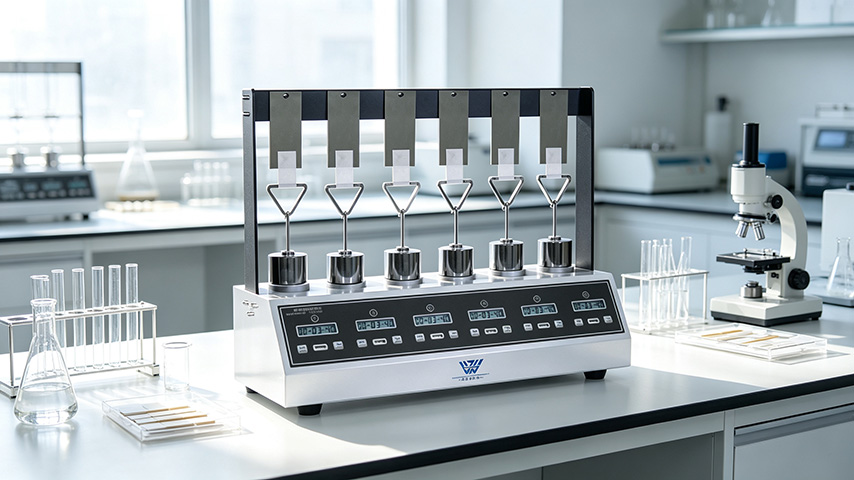
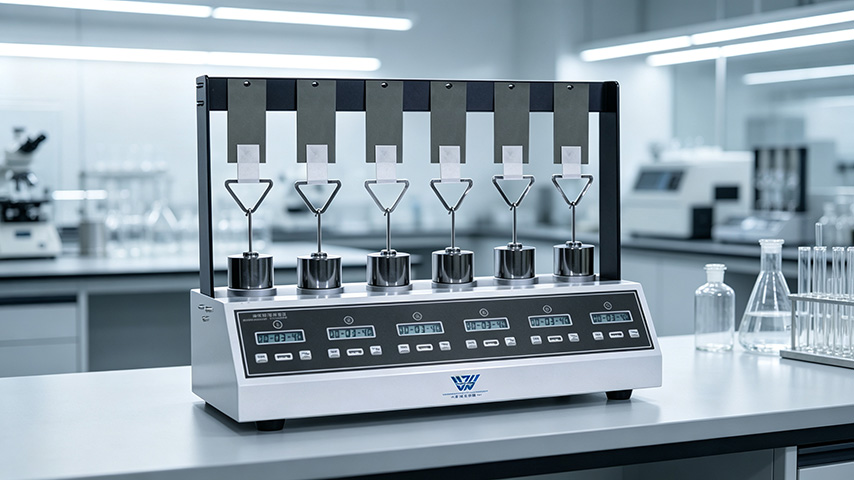
A holding power tester is, in essence, a controlled fixture combined with a timing system. The fixture holds a number of test stations, each with a panel, a clamp, and a weight. The timing system records when each sample fails.
The number of stations is one of the most important practical considerations. Because holding power tests run for minutes, hours, or even days, a single-station device creates a bottleneck. A multi-station instrument allows several samples to be tested in parallel, which is essential in a production or quality-control environment.
Why Temperature Control Matters
Holding power is strongly temperature-dependent. Adhesives are viscoelastic materials, and their resistance to creep falls as temperature rises. A tape that holds for a week at room temperature may fail in hours in a hot container or warehouse.
For this reason, many standards specify a test temperature, and a proper label adhesion tester or holding power setup may include a temperature-controlled chamber. A manufacturer that ships into hot climates, or that supplies the automotive or electronics industries, will often need to verify performance at elevated temperatures rather than relying on room-temperature results alone.
Choosing the Right Equipment
Selecting the right instrument begins with the standard that must be met. Most of the tests for international customers are conducted in accordance with ASTM D3654 standard. The equipment should be configurable to the relevant standard, and the data should be reportable in the required format.
The next consideration is sample throughput. A laboratory that tests occasionally can operate with fewer stations, while a production line that tests every shift needs enough stations to keep pace. The weights and panels supplied with the instrument are part of the purchase decision too: they must match the standard and be present in sufficient quantity, because a missing or non-standard weight makes the measurement meaningless.
Finally, the material range matters. A sticker adhesion test setup, a tape test, and a label test all involve different widths and substrates, so the clamps and hanging mechanism must accommodate the specific products being tested.
Holding power is the property that answers a simple but important question: once something is stuck, will it stay stuck? Initial tack tells a manufacturer whether a tape will grab, but holding power tells it whether that grab will last.
The instruments that measure this property—whether called a pressure sensitive adhesive tape tester, an adhesive tape testing machine, or a tape adhesion test instrument—all serve the same purpose: converting a long, slow failure process into a number that can be specified, verified, and compared. In an industry where a bond that fails days after application can be more costly than one that fails immediately, that measurement is not a technical detail. It is the difference between a product that works and one that comes back.
Get the latest price? We'll respond as soon as possible(within 12 hours)