



The Electronic Bottle Wall Thickness Gauge: How It Works and Why It Matters
2026-09-09 17:26In the packaging industry, a bottle is rarely judged only by how it looks. What matters just as much is how it is made — and, in particular, how evenly the material is distributed across its walls and base. This is where instruments like the bottle wall thickness gauge and the bottle bottom thickness tester come in. These devices belong to a broader family of dimensional measurement tools that also includes the general-purpose thickness gauge and the wall thickness tester. Their job is simple to describe but difficult to do well: measure the thickness of a container's wall and base accurately, repeatably, and without damaging the sample.
The Problem These Instruments Solve
When a bottle is blow-molded or formed, the material does not always flow uniformly. Thin spots can form near the shoulder, along the sidewall, or at the base. A wall that is too thin may collapse under stacking pressure or fail during capping. A base that is too thin can crack when the bottle is dropped or filled. For manufacturers of beverages, pharmaceuticals, cosmetics, and food products, these defects are not cosmetic — they are a direct risk to product safety and shelf life.
A bottle thickness gauge gives quality-control teams a way to quantify this risk. Instead of relying on visual inspection, which cannot detect sub-millimeter variations, the operator can place a probe against the wall or base and read a precise numerical value. This turns a subjective judgment into an objective measurement that can be recorded, tracked, and compared against a specification.
Mechanical and Electronic Measurement
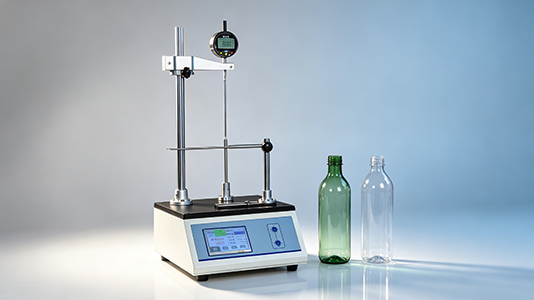
Historically, many wall-thickness instruments were purely mechanical. They used a dial indicator and a fixed anvil, and the operator read a needle position on a graduated face. These devices are robust and inexpensive, but they require careful reading and are prone to human error.
The digital thickness gauge changed this. By replacing the mechanical dial with an electronic sensor and a liquid-crystal display, the instrument removes the ambiguity of reading a needle. The value appears directly as a number, often to a resolution of 0.001 mm. This is significant for thin-walled containers, where a difference of a few hundredths of a millimeter can determine whether a bottle passes or fails.
An electronic wall thickness tester typically offers additional advantages. Many models can hold a reading, switch between millimeters and inches, or transmit data to a computer for statistical process control. Some can be fitted with custom measuring rods or anvils to accommodate irregular shapes, textured surfaces, or hard-to-reach areas such as the inside of a bottle neck.
Wall Thickness and Bottom Thickness
Although they are often discussed together, wall thickness and bottom thickness are measured with different considerations in mind.
Wall thickness is usually measured at several points around the circumference and along the vertical axis of the bottle. Because blow-molded containers can vary from point to point, a single reading is rarely enough. Quality-control procedures commonly specify a minimum wall thickness at the thinnest point, and the operator must scan the surface to locate it.
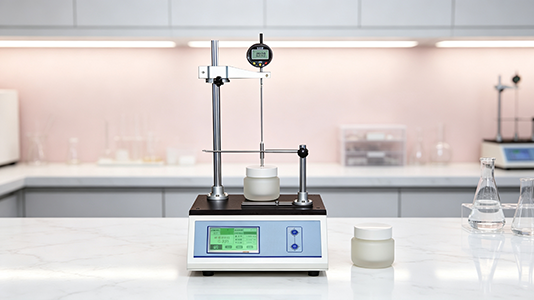
Bottom thickness presents its own challenge. The base of a bottle is often thicker than the wall and may have a concave or recessed design that makes access difficult. A dedicated bottle bottom thickness tester is designed with a probe and support geometry that allows the operator to reach the center of the base, where thickness is most critical. In many instruments, the same device can measure both wall and bottom, with interchangeable fixtures or a repositionable probe.
Where These Instruments Are Used
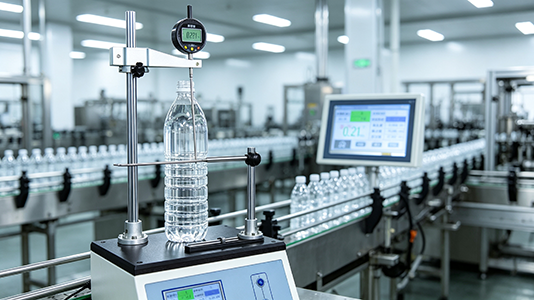
The applications span a wide range of industries. Beverage producers use them to check PET and glass bottles. Pharmaceutical and health-product manufacturers verify that medicine bottles and supplement containers meet dimensional standards. Cosmetic companies check jars and bottles for uniform wall thickness that affects both appearance and durability. Food producers apply the same checks to containers for edible oil, sauces, and other packaged goods.
In each of these settings, the instrument serves the same purpose: to confirm that the container will perform as intended throughout filling, sealing, transport, and storage.
Choosing the Right Instrument
When selecting a bottle thickness instrument, several factors deserve attention. The measuring range must cover the expected wall and base thickness of the containers being produced. The resolution should be fine enough to detect the smallest variation that matters. The geometry of the probe and support should fit the bottle shapes in use, including the ability to reach the base center and to accommodate textured or irregular surfaces. For electronic models, data output and display clarity are additional considerations.
In practice, a digital thickness gauge with a resolution of 0.001 mm and a range covering roughly 0 to 12.7 mm is a common choice for plastic and glass bottle inspection, with larger ranges available for thicker or larger containers.
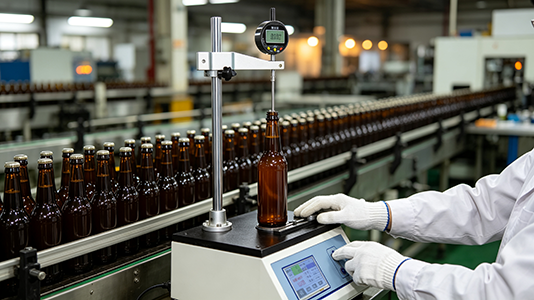
The electronic bottle wall and bottom thickness gauge is a modest-looking instrument, but it plays an outsized role in packaging quality control. By converting a difficult-to-see property into a precise, repeatable number, it allows manufacturers to detect thin spots before they become failures, verify compliance with standards, and maintain the consistency that consumers expect. Whether described as a bottle thickness gauge, a wall thickness tester, or a bottle bottom thickness tester, the underlying purpose is the same: to make sure every container is as strong and reliable as it should be.