



Electronic Peel Tester: Understanding Peel Strength Testing in Materials
2026-09-07 17:16Peel testing is one of the most widely used methods in materials quality control, yet it is often misunderstood. At its core, a peel tester measures the force required to separate two bonded or laminated materials at a controlled angle and speed. This measurement, known as peel strength, tells engineers and quality inspectors how well an adhesive bond, a laminated film, or a coated surface will hold up under real-world conditions.
Understanding how these instruments work, what they measure, and how to interpret their results is essential for anyone involved in packaging, adhesives, medical devices, or flexible material production.
What Peel Strength Actually Measures
Peel strength is defined as the force needed to peel a flexible material from a rigid substrate, or to separate two flexible materials, expressed per unit width of the specimen. The value is typically reported in newtons per millimeter (N/mm) or newtons per 25 mm, depending on the standard being followed.
Unlike tensile strength, which measures resistance to a straight pull, peel strength captures a more complex failure mode. When two materials are peeled apart, the force is concentrated along a narrow line at the point of separation. This makes peel testing particularly sensitive to the quality of the adhesive bond, the surface preparation, and the uniformity of the coating or lamination. A small defect anywhere along the bond line will show up as a dip in the measured force, which is exactly what makes the peel strength tester such a valuable diagnostic tool.
How a Peel Tester Works
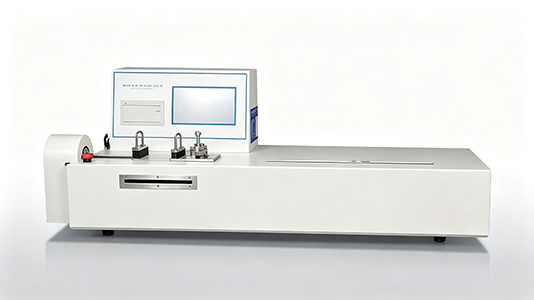
A modern electronic peel tester operates on a simple but precise principle. The specimen is clamped so that one layer is held stationary while the other is pulled away at a constant, controlled speed. A load cell measures the force continuously during the peel, while a displacement sensor tracks the movement. The result is a force-versus-displacement curve from which the average peel strength, the peak force, and the force fluctuation can all be derived.
The electronic peel tester differs from older mechanical instruments in several important ways. Because the drive is servo-controlled, the peel angle and speed remain constant throughout the test, which is critical for reproducible results. The digital readout and data acquisition eliminate the reading errors that occur with analog gauges. And because the data is captured electronically, it can be stored, compared across batches, and exported for quality documentation.
The Role of Peel Angle
One of the most important variables in peel testing is the peel angle. The two most common configurations are the 90-degree peel test and the 180-degree peel test. The choice of angle depends on the application and the standard being followed.
In a 180-degree peel test, the flexible material is folded back over itself and pulled parallel to the substrate. This is the standard method for pressure-sensitive adhesive tapes and many laminated films. In a 90-degree peel test, the flexible layer is pulled perpendicular to the substrate, which is common for rigid-to-flexible bonds such as a coating on a metal or plastic panel.
The peel angle matters because it changes the stress distribution at the peel front. A 90-degree peel applies a more direct tensile component to the bond, while a 180-degree peel introduces more bending of the flexible layer. For this reason, results from different angles are not directly comparable, and it is essential to specify the angle when reporting peel strength values.
Speed, Temperature, and Other Variables
Peel strength is not a single fixed property of a material; it depends heavily on the test conditions. The peel speed, in particular, has a strong influence on the result. Most adhesives are viscoelastic, meaning their resistance to separation increases with the rate of loading. A peel test run at 300 mm/min will often give a different value than one run at 50 mm/min, even on the same material. This is why standards specify a precise test speed, and why a digital peel strength tester must offer accurate, repeatable speed control.
Temperature is another significant factor. Adhesives become stiffer and more brittle at low temperatures and softer at high temperatures, both of which alter the measured peel strength. For applications where the bonded product will be exposed to temperature extremes, peel testing should be conducted under temperature-controlled conditions.
Specimen preparation is equally important. The width of the specimen, the surface cleanliness, the application pressure of the adhesive, and the dwell time before testing all influence the result. A well-designed peel strength test machine is only as reliable as the consistency of the sample preparation that precedes it.
Common Applications
Peel testing finds application across a remarkably wide range of industries. In packaging, it is used to verify the seal strength of flexible pouches, the lamination bond of multi-layer films, and the adhesion of labels. In the adhesive tape industry, peel strength is the primary specification for pressure-sensitive tapes, with standards such as ASTM D3330 governing the test method.
In the medical device field, peel testing verifies the adhesion of transdermal patches, wound dressings, and the sterile barrier seals of medical packaging. The automotive and electronics industries use peel testing to check the bond of laminates, coatings, and flexible circuits. In each case, the peel strength tester provides the objective, repeatable data that quality decisions require.
Interpreting the Results
A peel strength test produces more than a single number. The force-versus-displacement curve reveals the character of the bond. A smooth, consistent curve indicates a uniform bond, while a jagged curve with large fluctuations suggests an uneven coating, an inconsistent adhesive layer, or surface contamination. The average peel strength, the peak force, and the standard deviation across multiple specimens together provide a complete picture of the bond quality.
For quality control purposes, it is common to test multiple specimens from the same batch and compare the average and spread against an established specification. This statistical approach is what separates a meaningful quality program from a one-off measurement, and it is one of the areas where the data-handling capability of a modern electronic peel tester proves its value.
The peel strength test machine has become an indispensable instrument in materials quality control because it converts a subtle physical property — the strength of a bond — into objective, quantifiable data. Understanding the principles of peel testing, the influence of angle and speed, and the proper interpretation of results allows engineers and quality professionals to use these instruments effectively and to make sound decisions about the materials they produce and purchase. Whether the application is packaging, adhesives, or medical devices, a reliable peel tester provides the measurement foundation on which product quality ultimately rests.